

Key Insights: LED Solar Simulators, Bifacial R&D, Multijunction PV
The future of photovoltaics shines brightest when both sides see the light. There are several considerations in designing accurate solar simulators to test both front-side and rear-side (bifacial) illumination scenarios. LED solar simulators are used successfully in multiple configurations to advance research and development and improve solar conversion efficiency. Stability and spectral match are key, and uniformity is particularly important for modern advanced photovoltaics such as tandem perovskite, heterojunction, and multijunction cells. In addition, exploration of the latest PV materials necessitates an expanded spectral range. Individually controllable wavelengths, such as in Innovations in Optics’ (IOI) Class A+A+A+ LumiSun™ series, also add measurement flexibility and fine-tuning of the spectrum to meet each investigator’s needs.
Modern PV – Harvesting more Photons
Today’s photovoltaics are no longer a single thick Si junction. Tandem and multijunction solar cells capture different parts of the solar spectrum more efficiently. These next-generation cells have very tight margins for current matching, spectral sensitivity, lateral carrier flows, and local heating effects. The typical IEC Class A spatial non-uniformity of < 2% may no longer provide sufficient research-grade accuracy. In fact, Class A+ (< 1 % nonuniformity) along with low spectral deviation is becoming a necessity for advanced PV studies. Compared to arc lamps with their spatial structure and drift, LED arrays with precision optics enable designed uniformity with individually addressable channels, adjustable power distribution, and spectral mixing. It is also advantageous to have Class A+ nonuniformity for each wavelength independently.
To review, Class A+A+A+ solar simulators, such as the LumiSun™ series, and Class AAA have the following definitions for spectral match, non-uniformity of irradiance, and temporal instability:1
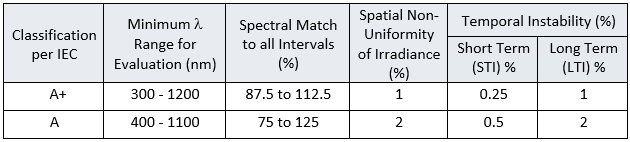
Table 1: Definition of Class A+A+A+ and Class AAA solar simulators per IEC 60904-9 Edition 3.0 2020-09.
In addition, Spectral Coverage (SPC) and Spectral Deviation (SPD) are important measures beyond Class, and they are defined by the IEC as:2
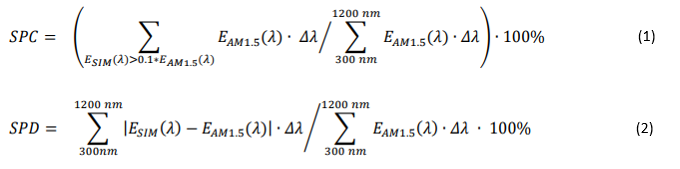
To provide high accuracy in testing and research, users should select Class A+A+A+ with high SPC and low SPD, and with individual control of each wavelength to enable custom spectra.
Testing a Bifacial PV System
Researchers often combine bifacial capability (two-sided light collection) with tandem or multijunction solar cells (multiple bandgap layers) to maximize performance. For example, a wide-bandgap perovskite top cell absorbs visible light, while a narrower-bandgap bottom bifacial Si, CIGS, or CdTe junction absorbs NIR radiation and the rear-side albedo. Thus, it is important to understand device performance over a broad range of illumination conditions.
An LED solar simulator’s flexibility in spectral output enables testing under numerous rear-side reflectance scenarios. Figure 1 shows a typical bifacial PV system concept. With more surface area available to absorb sunlight, bifacial multijunction panels can exceed 30% efficiency. The extent of their advantage over monofacial cells also depends on the environment – particularly the reflectivity (albedo) of the installation site. Bifacial solar panels perform best when the light passing through or around the panel strikes a highly reflective surface such as glass, stone, or snow. The rear-side reflection can add another 5 – 30% relative energy gain compared to monofacial cells, depending on ground reflectivity and system geometry.
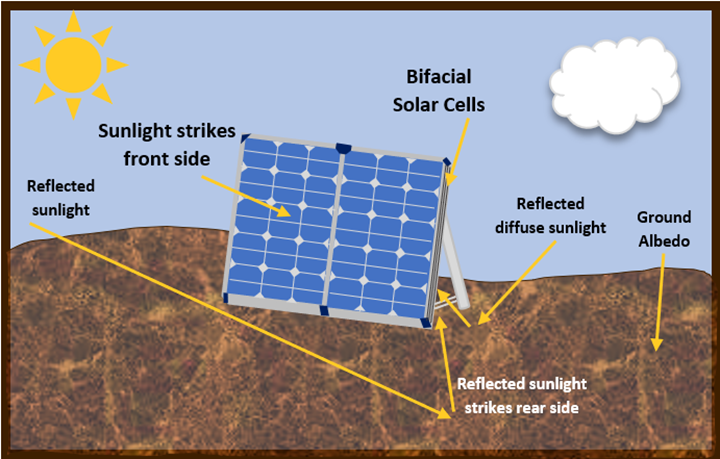
Figure 1: Bifacial solar panel configuration
Characterizing that reflectance is critical to determining the overall improvement in efficiency. The best LED solar simulators for bifacial configurations feature a large number of independently controlled wavelengths spanning a broad spectral range, including the NIR to accurately capture ground albedo. Figure 2 shows the spectral reflectance of common environmental surfaces, with snow as the highest, and concrete as the lowest.
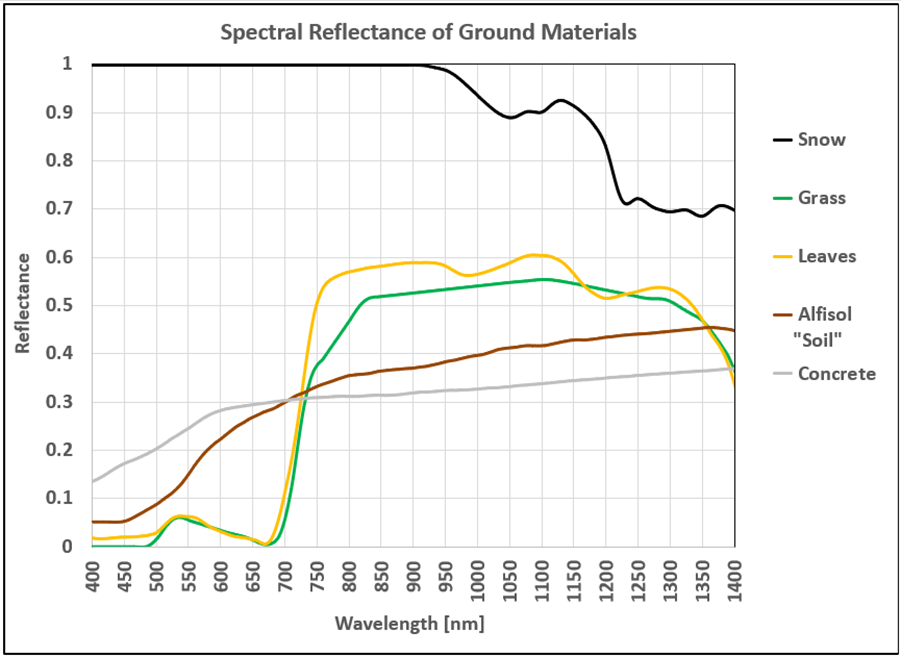
Figure 2: Spectral reflectance of snow, grass, leaves, soil, and concrete. Higher albedo surfaces enhance rear-side illumination and improve total power generation for bifacial systems.
As a bifacial multijunction example, consider CdTe used with Sn-based perovskites (0.9 – 1.1 eV), which can extend the response range out to 1250nm. An LED solar simulator with at least 35 independently adjustable wavelengths, such as the IOI LumiSun™ series, can effectively cover the full range from 360 to 1250nm. Figure 3 illustrates the coverage for two solar simulators vs. the AM1.5G reference spectrum, along with the reflectance of various ground surfaces. A solar simulator with fewer LEDs (< 10) may meet Class AAA specifications, but it suffers from high spectral deviation and limited NIR coverage. In contrast, a 35-wavelength Class A+A+A+ LED solar simulator has low spectral deviation and broader spectral coverage, enabling high-accuracy characterization of bifacial multijunction solar-cell performance out to 1250nm under rear-side illumination.
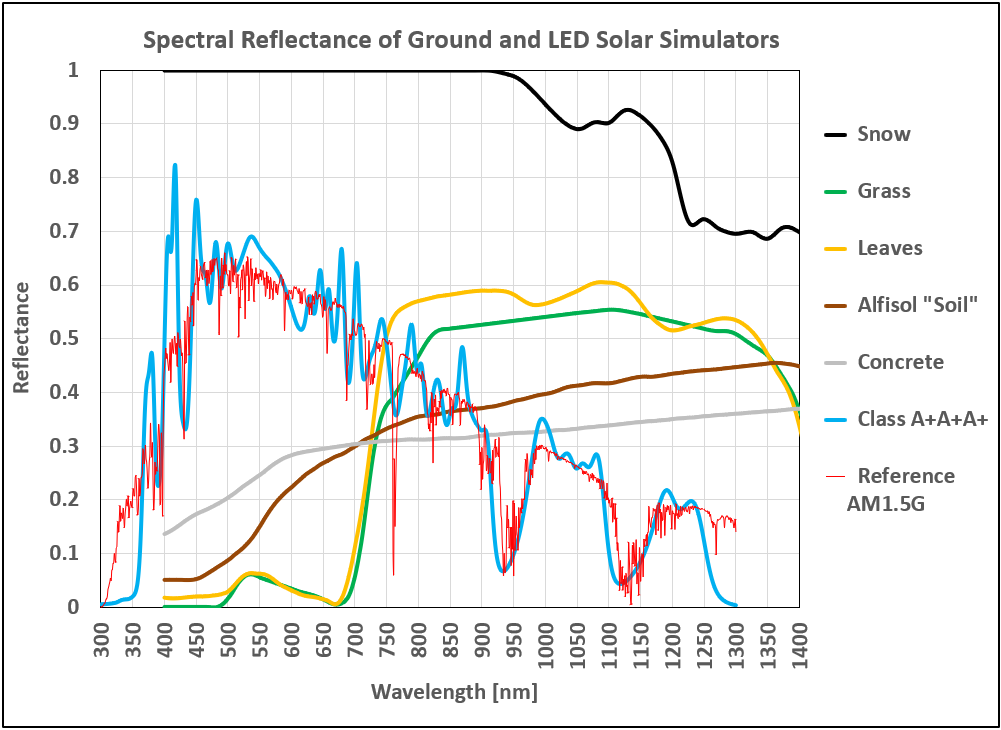
Figure 3: LED Solar Simulator with 35 wavelengths enables high accuracy assessment of bifacial multijunction solar cell performance out to 1250nm for rear-side illumination.
The reflectivity of rear-side materials can be analyzed with high precision when using a solar simulator that offers low spectral deviation and Class A+A+A+ performance. Also, though the heat load for the rear-side illuminator is lower than that of the front side, maintaining a stable and constant temperature is essential to ensure temporal stability and reliable measurement results.
Conclusion
LED solar simulators are essential to advancing bifacial and multijunction photovoltaics – systems that thrive on light from all directions for increased efficiency. Highly uniform, low spectral deviation simulators can be finely tuned to use individual wavelengths and the entire spectrum from UV to NIR to study solar cell performance with unprecedented accuracy and control.
At IOI, we don’t fight the dark side – we light it, precisely.
May The LED Light be strong in your solar research.
NOTES/REFERENCES
1 IEC 60904-9 Edition 3.0 2020-09 Photovoltaic devices – Part 9: Classification of solar simulator characteristics. Pages 9 – 12
2 IEC 60904-9 Edition 3.0 2020-09 Photovoltaic devices – Part 9: Classification of solar simulator characteristics. Pages 11 – 13
3 NREL Conference Paper, October 2019: Bifacial PV System Mismatch Loss Estimation and Parameterization