


Key insights: LED die brightness, optimizing IQ
Are some LED light engines smarter than others? Absolutely! Let’s just say that their IQ (Illumination Qi) can vary significantly, and high brightness alone does not ensure success. Four die are not always better than one. On the other hand, it could be that many die make light work. How does one know?
Light emitting diodes (LEDs) emerge into this world through the combination of unique materials and growth processes that produce varied sizes, colors/wavelengths, strength, and innate ability. The key to optimizing their lives is understanding and appreciating their differences for a given application.
What are Power and Brightness?
Brightness is perceived luminance and typically refers to those LEDs emitting in the visible. However, in consideration of all LED wavelengths, it is appropriate to use radiometric definitions. Unlike photometric units, radiometric units refer to the absolute optical power of a source without a nod or a wink to the human eye’s sensitivity. One can convert between radiometric and photometric units via the photopic spectral luminous efficiency curve V(λ), which is the spectral response of the human eye vs. wavelength – per the Commission International de l’Éclairage (CIE) and the ISO.
For now, we will use radiometric to describe LED or light engine performance. Figure 1 features radiometric terms, units, and their corresponding photometric units.
| RADIOMETRIC TERM | DESCRIPTION | RADIOMETRIC | PHOTOMETRIC |
| Radiometric Flux | Power | W | Lumen (lm) = cd·sr |
| Irradiance | Power per unit area | W/m2 | Lux (lx) = cd·sr/m2 = lm/m2 |
| Radiant Intensity | Power into solid angle | W/sr | Candela (cd) |
| Radiance | Power per unit area per unit solid angle | W/m2·sr | Cd/m2 = lm/m2·sr |
Figure 1: Radiometric and Photometric Units
Depending upon the application, the end user often needs not only power or brightness, but high uniformity and temporal stability as well. Other considerations include single or multi-wavelength capability and, perhaps most importantly, lifetime. When designed with appropriate thermal management to keep the LED die junction temperature low, LED light engines provide tens of thousands of hours of lifetime. Furthermore, environmental safety and low operational costs make them an effective replacement for arc lamps and lasers.
Maximizing Output Power
If there were no limitations on space, thermal effects, or coupling efficiency, we could specify ever-increasing numbers of die for a given light engine and obtain an endless supply of photons. Unfortunately, those constraints are the reality for a systems designer. Several strategies can be employed to address this. Compact non-imaging collection optics reduce the size of the light engine while increasing the uniformity, particularly when mixing multiple wavelengths. Additionally, working with bare die is an advantage that allows the designer to close pack the array and mount directly to a copper substrate. With greater numbers of die, each die can be driven at a lower current, thus extending their lifetime for the same optical power output. However, the maximum effective number of die is inherently limited by the Étendue, or Optical Invariant, of the optical system. In applications using fiber coupling, matching both numerical aperture (NA) and clear aperture (CA) of the fiber to that of the light engine is critical for high throughput. When the fiber or liquid light guide parameters are smaller than the nominal values of a given light engine, the coupling efficiency is reduced by the square of the ratios (NAf/NAo)2 and/or (CAf/CAo)2.
LED Die with the Highest IQ
LED die continue to improve and it is important to stay apprised of the latest high-power bins and wavelengths readily available with lower forward voltage. Figure 2 below shows relative output power for a wide range of wavelengths. Die with lower forward voltage enable longer lifetime for the same drive current and they have increased capability for short pulse operation. Additionally, the newer P-up die designs have more uniform and lower average current density which leads to less heating and better thermal uniformity, and, hence, longer lifetime as well. VCSEL technology (Vertical Cavity Surface Emitting Lasers) is an option for higher power in the IR with advantages similar to LEDs such as eliminating speckle.
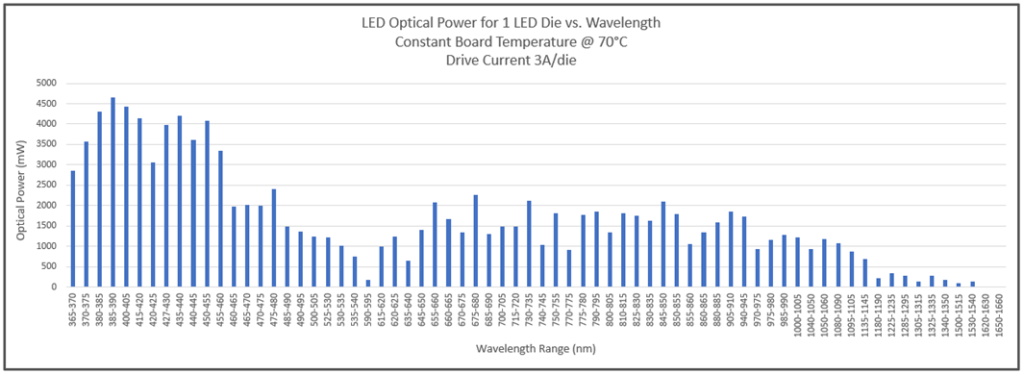
Figure 2: One LED die power output for sample wavelengths illustrates the variation in strength from UV – VIS – NIR.
If your application is not particularly wavelength or polarity sensitive, advances in one wavelength bin could motivate a change in die. For example, blue die are available in multiple wavelength bins, P-up and P-down. Figure 3 shows test data for two different blue wavelengths – 450nm P-up and 474nm P-down. The radiometric flux for the newer 450nm P-up die is nearly double that for the 474nm and illustrates the importance of specifications and making an informed choice.
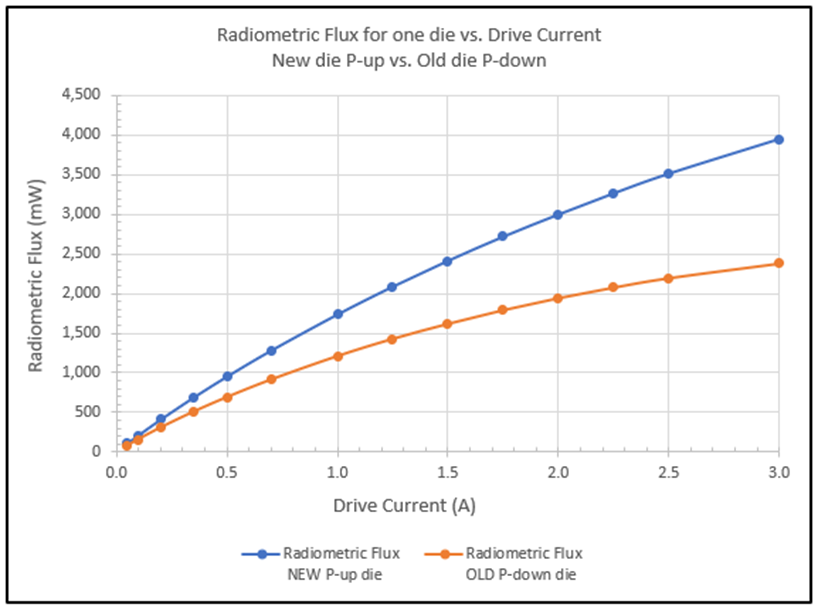
Figure 3: Test data show improved die performance for 450nm P-up (cathode ground) compared to longer wavelength of 474nm P-down (anode ground).
White die have also experienced improvements in power output which increases the capability for light engines used in ophthalmology, industrial inspection, endoscope illumination, and solar simulators. Figure 3 shows an example of new white die that have at least 20% more optical output power compared to an older version.
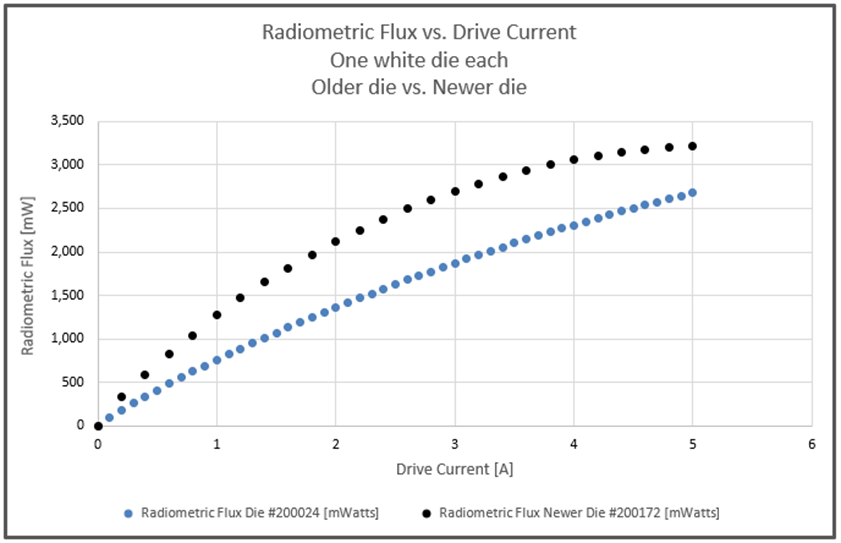
Figure 4: New white die with 20% more output.
The Brightest Light Engine
Most applications benefit from high brightness, and machine vision is certainly no exception. When a designer considers all the factors mentioned above, it is possible to produce a cost-effective LED light engine with superior performance. Figure 5 illustrates an Innovations in Optics LED point cloud projector with nine times the brightness compared to the leading competitor. The die are selected for reliability, high output, and maximum efficiency, and close packed to capture as many photons as possible.
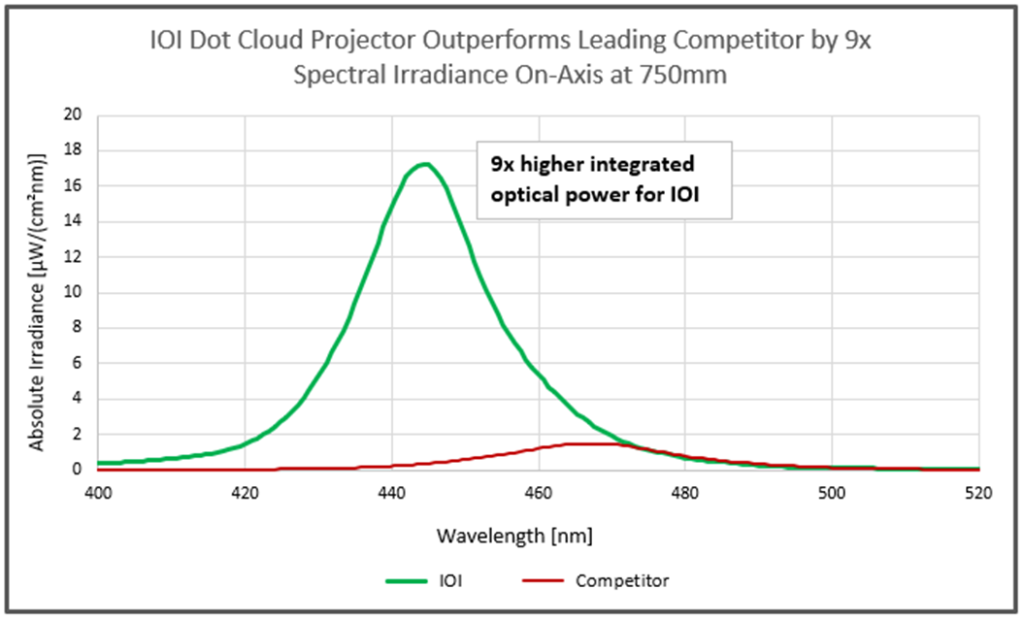
Figure 5: Pattern projector optimized for high brightness with six times the intensity at 750mm WD.
Conclusion
For those interested in a high IQ light engine, it is important to understand not only the latest LED die capability, but the complexities of their implementation as well. Keeping the die junction temperature low, selecting die with low forward voltage, maximizing system throughput and coupling efficiency, and reducing system losses all contribute to a successful light engine life.
LED light engines are the intelligent choice.